
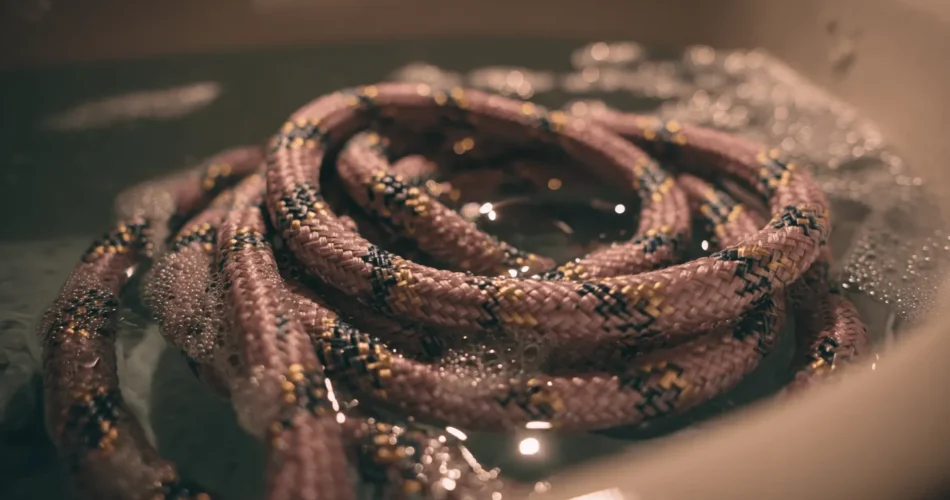
Your climbing rope is literally your lifeline—the single most important piece of gear you own. But after a few seasons of gym climbing, projecting on gritty limestone, or dragging it across dirty crags, that bright, supple cord starts to look dull, feel stiff, and leave black gunk on your hands.
Giving your rope a proper bath isn’t just about aesthetics; it’s a vital safety and maintenance task! Cleaning helps remove abrasive debris and grit that can wear down the sheath and core from the inside, significantly extending your rope’s life and restoring its smooth handling. Check out this video that walks you through the whole rope washing process:
Related Articles
How to Tie a Rock Climbing Knot
How to Clean Rock Climbing Shoes
What to Wear Rock Climbing
Why Your Rope Needs a Spa Day (The Dirt Science)
When your rope lies on the ground, tiny, abrasive particles—like sand and granite crystals—work their way past the sheath and into the core. Since the core is the main load-bearing element of your rope, this is a major problem. Every time the rope flexes, these particles grind against the internal fibers, acting like sandpaper. This internal abrasion can potentially reduce the rope’s Minimum Breaking Strength (MBS) by up to 50%.
Even if you only climb indoors, chalk dust can be a significant cause of abrasion, so gym ropes need cleaning, too.
When Do You Know It’s Time to Clean?
The frequency of cleaning depends entirely on how often you use your rope and how well you manage it (pro tip: always use a rope tarp!).
You should clean your rope when:
- It literally looks dirty or has black marks.
- It starts to feel stiff, awkward, or difficult to handle.
- You notice your hands or belay device getting grimy and black when you use it.
On average, cleaning once a season or every couple of seasons is a reasonable range.
The Golden Rules: What NOT to Use or Do
When dealing with high-performance nylon, a lot of common household cleaning habits can actually damage your rope permanently.
| Material or Action | Why Avoid It? | Retirement Mandate |
| Bleach/Oxidizing Agents | Causes severe, irreversible damage to nylon and polyester fibers. | IMMEDIATE RETIREMENT is mandatory if contact is confirmed. |
| Strong Acids (Battery, Muriatic) | Can rapidly hydrolyze (literally melt) nylon polymer chains, causing catastrophic, often invisible, strength loss. | IMMEDIATE RETIREMENT is mandatory. |
| Hot Water | Can permanently damage synthetic fibers, remove performance-improving fiber finishes, or melt/change the properties of internal adhesives used in rope construction. | Only use cool or lukewarm water (max 30°C / 86°F). |
| Harsh Detergents | Can strip factory-applied thread coatings and lubricants that protect against UV and abrasion. | Use only mild, pH-neutral, non-bleach detergents, or rope-specific wash. |
Choose Your Adventure: Hand Wash vs. Machine
You have two main methods for washing your rope: by hand in a tub (the gold standard) or by machine (with strict conditions).
| Feature | Hand Washing (Tub/Bucket) | Machine Washing (Front-Load Only) |
| Pros | Maximum control over the process; guaranteed rinsing; zero risk of machine damage. | Faster; hands-off during the cycle. |
| Cons | Time consuming; requires physical effort. | Requires a front-load machine (no agitator); risk of tangle/stress if improperly prepped; harder to confirm chemical residue is gone. |
| Agitator | N/A | STRICTLY FORBIDDEN: Agitators can tangle, twist, and damage ropes and break the machine. |
Option 1: Hand Washing (The Safest Route)
This method takes longer, but it gives you complete control and is universally recommended as the safest route.
- Prep the Area: Flake your rope loosely into a clean bathtub or a large plastic storage container. (Pro-tip: A plastic container keeps the resulting grime from scratching your tub!).
- Add Water: Fill the tub until the rope is completely submerged, using cool or lukewarm water (maximum 30°C / 86°F).
- Add Detergent (Optional): Pour in your chosen mild cleaner (see section below).
- Agitate and Soak: Gently swish and knead the rope by hand along its entire length to release the dirt. If the rope is exceptionally dirty, let it sit and soak for 15 to 60 minutes before agitating again.
- Scrub (Optional): For particularly tough spots, run the rope through a dedicated rope brush or use two soft-bristle scrub brushes to create a brush sandwich.
- Rinse, Rinse, Rinse: Drain the dirty water. Refill the tub with clean, lukewarm water and agitate the rope again. You need to repeat this drain-and-refill process until the water runs completely clear (usually 2 to 3 times, but possibly more).
Option 2: Machine Washing (If You Must)
If you have access to the right kind of machine and are pressed for time, this method works, but you must follow the rules strictly.
- Machine Type: Use a front-loading machine only. Top-loaders with an agitator are forbidden.
- Pre-Rinse Protocol: If this isn’t your personal machine (like a laundromat), run an empty hot cycle first to rinse out any potential bleach or harsh chemical residue left by previous users.
- Rope Prep: Flake the rope into a mesh laundry bag (or similar sack) or daisy chain the rope completely. Do not throw the rope in loosely—it will tangle severely, potentially damaging the rope and the machine.
- Settings:
- Temperature: Use the Cold setting (less than 30°C / 86°F).
- Cycle: Use the Delicate Cycle.
- Spin Cycle: DISABLE THE SPIN CYCLE. High-speed spinning subjects the heavy, wet rope to damaging stress.
- Rinsing: Run a minimum of two rinse cycles (a double rinse) to ensure all soap residue is flushed out.
The Cleaners: Soap or No Soap?
Many manufacturers recommend only using plain water. However, if your rope is greasy or exceptionally dirty, using a mild soap is acceptable.
The safest and best choice is always a dedicated rope-specific cleaner:
- Rope-Specific Washes: These are formulated to be pH-neutral and free of additives that damage nylon or strip performance coatings. Brands include Sterling Rope Wash™, Beal, PMI, Tendon, and Teufelberger (Maxim).
- Mild Alternatives: If specialty wash isn’t available, look for a very mild, pH-neutral soap. Good alternatives include gentle soaps like baby shampoo or unscented Dr. Bronners (Castile soap). Plant-based “eco” or “baby” laundry formulas free of dyes, optical brighteners, and fragrances are also viable options.
Do not use Woolite (it can be acidic), bleach, color brighteners, stain removers, or fabric softeners. Fabric softeners, in particular, can hinder complete drying.
A Note on Dry-Treated Ropes
If you have a dry-treated rope, washing it with water only is the best option. While internal testing isn’t public, studies suggest that using any kind of soap might reduce the dry treatment coating.
Drying is Critical (Don’t Rush This!)
Improper drying can ruin your rope and undo all your hard work. This process must be treated as a controlled safety step.
The Rules of Drying:
- DO: Flake the rope out loosely on the ground or floor. A clean tarp or contractor bag is ideal to protect your floors.
- DO: Air dry in a cool, dark, and well-ventilated area.
- DO: Expect drying to take 24 to 48 hours (or longer, depending on humidity). You may use a fan to circulate air.
- DO NOT: Use a tumble dryer or any form of artificial heat (like a heater or fire). Heat can damage the nylon and internal rope construction.
- DO NOT: Place the rope in direct sunlight. Wet nylon is particularly sensitive to UV rays, which accelerate aging and cause stiffness.
- DO NOT: Hang the wet rope tightly, as the weight of the water can cause uneven stretching.
Tying This Up: The Final Safety Check
Cleaning your rope gives you the perfect opportunity to perform a mandatory safety inspection, which is much easier when the rope is clean and supple.
As you flake the now-clean rope, run every inch slowly through your hands (a tactile inspection). Feel for soft spots, flat sections, or sponginess—these are signs of a core shot (internal core damage).
- If the damage is extensive or located in the middle of the rope, retire the rope immediately.
- If the damage is found near one end, you might be able to trim off the compromised segment and melt the new end.
Remember, good care practices, proper storage (in a cool, dry place away from chemicals and sunlight), and cleaning can extend the functional life of your rope, but once safety is compromised, replacement is the only safe choice. Your rope is replaceable; you are not.
Where to find specialized rope cleaner:
Rope manufacturers offer specialized cleaning solutions designed specifically for nylon and polyester fibers. You can typically find these washes from climbing retailers or directly from the manufacturer websites. Brands that produce rope-specific washes include Sterling, Beal, PMI, Tendon, and Teufelberger (Maxim).