
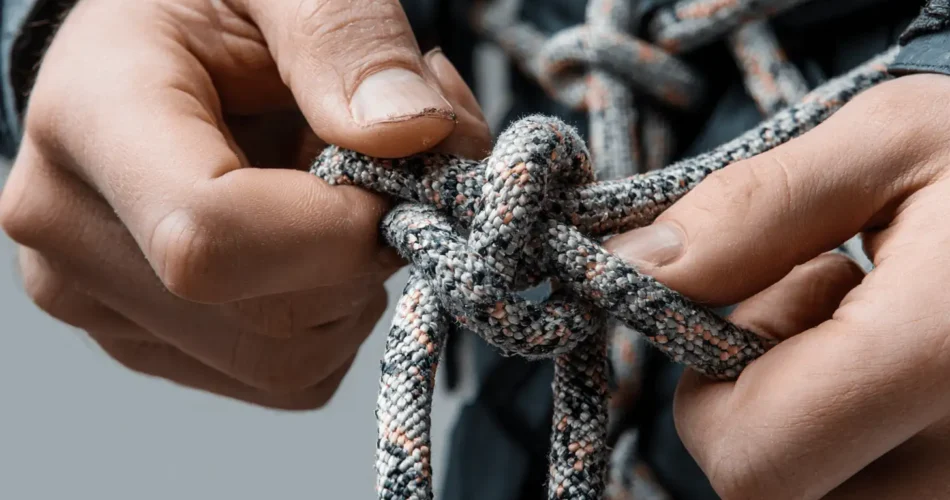
Hey climbers! Ready to lock in your safety system and climb with absolute confidence? Knot mastery isn’t just a useful skill; it’s the non-negotiable bedrock of system integrity in rock climbing. The difference between a solid day out and a scary moment often comes down to how well you tie, dress, and inspect your knots.
Related Articles
How to Wash a Rock Climbing Rope
What to Wear Rock Climbing
How to Increase Grip Strength for Rock Climbing
In climbing, we talk about three main types of “knots”:
- Knots (True Knots): Hold their form without needing to be tied around anything.
- Hitches: Must be tied around an object (like a carabiner or anchor) to hold together; they fall apart if the object is removed.
- Bends: Used specifically to join the ends of two separate ropes or cords.
Let’s dive into the essential knots you need for a secure day on the rock.
I. The Non-Negotiable: Figure Eight Follow-Through (F8FT)
If there is one knot every climber must master, it is the Figure Eight Follow-Through (F8FT). This is the universally established standard for connecting the climbing rope directly to your harness.
The F8FT is favored because it is strong, self-cinching, and reasonably easy to untie even after being heavily loaded. Crucially, its clean lines and visual symmetry make it incredibly straightforward for your climbing partner to inspect and verify—a vital safety attribute.
Tying the Figure Eight Follow-Through: Step-by-Step
This knot uses a rethreading technique to link the rope to a closed ring or your harness.
- Foundation: Start by tying a loose Figure 8 knot.
- Harness Integration: Pass the tail end of the rope through the two designated hard points on your harness (parallel to the belay loop, not through it). Pull the tail so the loose knot structure sits close to the harness.
- Retracing: Use the tail end to meticulously follow the exact path of the original Figure 8 around the entire knot in reverse. The tail must run parallel and adjacent to the standing end throughout this retrace.
- Completion: Exit beside the standing end to complete a two-stranded Figure 8 knot.
Technical Standards for Knot Security
Achieving maximum knot strength depends on precise execution.
- Dressing: The knot must be tied perfectly, meaning every strand should lie neatly parallel or “snugly nested” against its partner, with no crossed or twisted strands visible.
- Tightening: The knot must be pre-loaded and pulled tight. You must systematically pull tight on all four strands emerging from the finished knot: the lead rope, the tail end, and the two strands leading directly into the harness.
- Tail Management: Leave a minimum of four to six inches of tail beyond the finished knot. This provides a safety margin against potential slippage or “creep”.
Expert Note on Backup Knots: While some novices may use a stopper knot for added security against a poorly tied F8FT, experts often prefer a perfectly tied and tightened F8FT without a backup, arguing that adding extra loops increases bulk and the risk of mis-clipping.
The F8FT Safety Inspection Checklist (The “LOOSE” Mnemonic)
Mandatory partner inspection is essential every single time you tie in. Use this checklist:
| Inspection Component | Standard Requirement | Reason for Check |
| L – Location | Knot is snug and tight against the two harness hard points. | Ensures proper load distribution. |
| O – Opposite Direction | Tail strand retraces the original knot and exits parallel to the standing end. | Guarantees the rewoven structure is complete. |
| O – Overlaps/Dressing | Five pairs of lines are visible; no crossed or twisted strands. | Essential for maximum strength retention. |
| S – Snugness/Tightening | All four emerging strands have been individually pulled tight. | Confirms pre-loading to prevent creep under initial load. |
| E – Extra Tail | Minimum 4–6 inches remaining beyond the knot. | Safety margin against potential knot creep. |
II. Essential Anchoring and Emergency Hitches
Hitches are critical for connecting yourself to an anchor point or for emergency belay situations.
A. The Clove Hitch
The Clove Hitch is super useful for attaching the middle of the rope to an anchor. Its main advantage is adjustability: you can easily adjust your distance from the anchor without fully untying the knot. It’s also easy to untie, even after taking a heavy load.
How to Tie the Clove Hitch (Two-Handed Method)
- Make two identical loops in the rope.
- Put the rear loop over the top of the front loop.
- Clip a screwgate carabiner through these two loops.
- Pull it tight and fasten the screwgate.
Safety Warning: Always use a screwgate carabiner with a Clove Hitch. A snapgate carabiner could allow one of the loops to be pulled through, causing the knot to fail.
The One-Handed Clove Hitch (Advanced Technique)
Mastering the one-handed Clove Hitch is crucial for efficiency, especially when you are holding onto the anchor with one hand at a precarious stance.
- Clip a screwgate to the anchor and hold it steady.
- Clip the rope through the carabiner.
- Grab the rope in your fist with your thumb pointing downwards.
- Bring your hand up, twisting the rope so your thumb points upwards and toward you.
- Push this newly formed twist through the gate of the carabiner and pull tight.
B. The Munter Hitch
The Munter Hitch is a friction hitch that can serve as an emergency belay or rappel device if your primary device is lost. It must be used with a large, pear-shaped HMS locking carabiner.
How to Tie the Munter Hitch
- Hold the rope in both hands and form a loop by crossing the rope over itself.
- Form a second, identical loop in the same way.
- Fold the two loops toward each other like you are closing a book.
- Clip a locking carabiner through both loops.
- Test the knot by pulling tight on either end; the knot should flip easily through the carabiner.
III. Joining Ropes and Specialized Friction Knots
When ascending fixed ropes, creating permanent cord loops, or joining two ropes for an extended rappel, specialized bends and hitches are required.
A. Double Fisherman’s Bend (DFB)
Also known as the Grapevine Bend, the DFB is one of the most trusted ways to securely join two ropes. It is ideal for creating permanent loops, such as Prusik loops, due to its incredible strength and resistance to slipping.
- Downside: The knot binds tightly under tension and can become nearly impossible to untie after being loaded heavily.
How to Tie the Double Fisherman’s Bend
- Place the ends of two ropes pointing in opposite directions so they overlap.
- With the end of one rope, wrap it twice around the body of the other rope (like forming an X).
- Pass the working end back through the two coils you just wrapped and pull to tighten the first knot.
- Repeat steps 2 and 3 identically on the other rope, wrapping in the opposite direction.
- Pull both ropes to cinch the two knots tightly together.
B. Flemish Bend (Rewoven Figure Eight Bend)
For joining two main climbing ropes for rappelling, the Flemish Bend is often preferred over the DFB because it is significantly easier to untie after loading.
- Tie a loose Figure 8 knot near the end of the first rope.
- With the end of the second rope, start meticulously retracing the entire path of the loose Figure 8 knot, following it exactly side-by-side.
- Ensure the finished knot has the rope ends coming out of opposite sides of the knot.
- Check for about a 1-foot tail and dress and stress the knot (pull slack out of all four strands).
C. Prusik Hitch
The Prusik Hitch is the most common friction hitch, used to connect a loop of thinner cord to a thicker rope. It is a staple for self-rescue, ascending fixed ropes, and crevasse rescue systems.
How to Tie the Prusik Hitch
- Place your cord loop behind the main rope.
- Feed the side with the connecting knot through the other side.
- Wrap the cord around the rope loosely and feed it through again at least three times. (Use more loops if extra grip is needed).
- Pull the hitch tight and dress it by making sure all the loops are parallel.
Conclusion: Practice Makes Perfect
Knot tying is fundamental to rock climbing safety. While knowing how to tie a knot is a great first step, achieving fluency—the ability to execute these foundational skills flawlessly, quickly, and even with one hand—is what defines mastery and enhances safety in exposed environments.
Remember the principles: meticulous dressing, thorough tightening, and diligent peer review. By prioritizing a clean, perfectly executed primary tie-in like the Figure Eight Follow-Through, and practicing essential hitches and bends until they become muscle memory, you significantly strengthen the integrity of your entire climbing system.
Critical Climbing Knots at a Glance
| Knot Type | Function | Primary Use Case | Key Safety Requirement |
| Figure Eight Follow-Through | Loop (Fixed Termination) | Tie-in to the harness. | Must be perfectly dressed and tightened on all four strands. |
| Clove Hitch | Hitch (Adjustable Attachment) | Self-tethering at anchors/adjusting anchor systems. | Must be used with a locking carabiner. |
| Double Fisherman’s Bend | Bend (Joining Ropes/Cords) | Creating permanent cordage loops (prusiks). | Difficult to untie after heavy loading (tends to weld). |
| Flemish Bend | Bend (Joining Ropes) | Joining two main ropes for temporary rappels. | Ends must exit on opposite sides; easier to untie than DFB. |
| Munter Hitch | Hitch (Friction/Emergency) | Emergency belay or lowering without a device. | Requires a large, pear-shaped HMS locking carabiner. |
Safety Disclaimer
Any activity that involves ropes is potentially hazardous. Lives may be at risk—possibly your own. Considerable attention and effort have been made to ensure these descriptions are accurate, but many critical factors cannot be controlled, including the choice, age, and condition of ropes, and the accuracy with which these descriptions are followed. No responsibility is accepted for incidents arising from the use of this material. In-person instruction from a qualified instructor is strongly recommended for any technique that, if done incorrectly, could result in serious injury or death.