
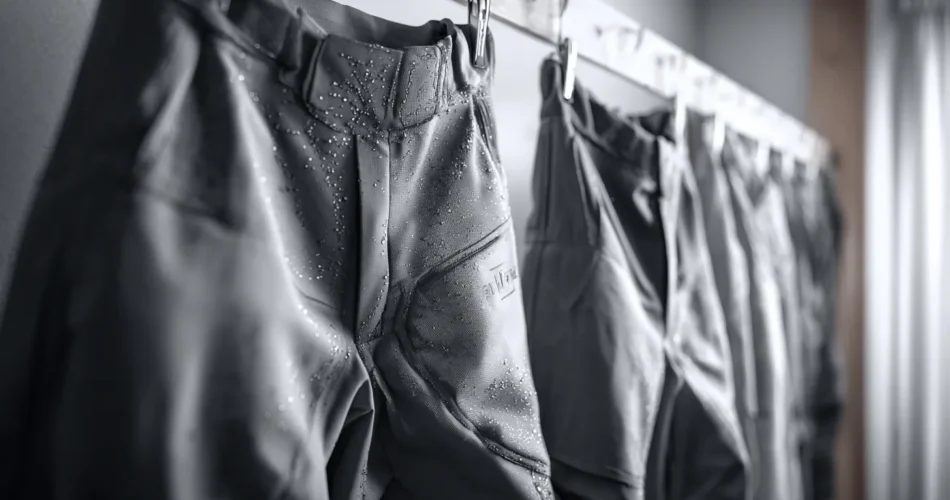
You invested serious cash in your technical snow pants—those heroes keep you warm and dry when you’re sessioning the park or hiking the backcountry. But unlike your regular jeans, you can’t just toss technical outerwear in with the rest of your laundry and call it a day.
Washing technical apparel correctly is essential because clean snow outerwear performs better. If you wash your pants the wrong way, you risk compromising the delicate waterproofing and breathability that makes them perform. We’re here to walk you through the simple steps to keep your pants performing season after season!
Related Articles
What to Wear Under Snowboard Pants
How to Wash Snowboard Jacket
How to Restore DWR
Why Your Technical Gear Needs a Spa Day (Understanding DWR)
Think of your snowboard pants as highly engineered systems. The magic lies in the Durable Water Repellent (DWR) coating—a finish on the outside of the fabric that causes water to bead up and roll right off. This is your garment’s first line of defense.
Over time, contaminants like sweat, dirt, body oils, and grime build up. This accumulation compromises the DWR’s ability to repel water, causing the fabric to soak through, a process known as “wetting out”. When your pants wet out, the garment loses breathability, and you start feeling clammy and cold inside, which is often mistaken for a leak.
The good news is that proper cleaning and drying help maintain and reactivate this crucial DWR performance.
Step 1: Prep Like a Pro (The Essential Checklist)
Before anything else, always check the manufacturer’s care label for specific instructions. Technical garments, especially those with specialized insulation or GORE-TEX membranes, may have unique requirements.
Here’s your pre-wash checklist:
- Empty Everything: Check every single pocket—chest, hip, vents, everywhere—and remove tissues, passes, energy bars, or anything that could cause damage or stains during the cycle.
- Secure All Closures: This is critical! Zip up the main fly, pocket zippers, leg vents, and fasten all snaps, studs, and especially Velcro straps. Open Velcro is abrasive and acts like sandpaper in the machine, potentially damaging the fabric.
- Loosen Drawstrings: Completely loosen any adjustable drawstrings or shock cords to prevent tangling.
- Spot Treat Stains: If you have stubborn mud, grease, or hot chocolate spots, pre-treat them. Use a damp cloth or apply a bit of technical detergent directly to the stain. Do not use standard store-bought stain removers or bleach, as these can chemically strip or damage the water-repellent treatments.
Step 2: The Wash Cycle—Handle with Care
Your snowboard pants are not cotton T-shirts. They need gentle handling to preserve their technical properties.
The Golden Rule of Detergent
This is the most important rule for technical gear care: Avoid regular household detergents and fabric softeners.
Fabric softeners are designed to coat fibers with waxy chemicals, which immediately neutralize the DWR and clog the breathable membrane pores, effectively killing your pants’ performance. Powdered detergents are also forbidden, as they can leave insoluble mineral fillers that physically obstruct the membrane.
Instead, use an additive-free, specialized liquid technical wash. These products, like those made by Nikwax or NST, are specifically formulated to clean without leaving residues that block breathability and water repellency.
- Product recommendation: You can purchase Nikwax Tech Wash (priced from $11.50 – $125.95) to clean your gear.
Machine Settings Cheat Sheet
To minimize mechanical stress and ensure thorough cleaning without damage, stick to these guidelines:
| Parameter | Recommendation | Rationale |
| Load Size | Maximum 2 items per cycle | Ensures better water circulation and rinsing efficacy, minimizing abrasion. |
| Cycle Setting | Gentle, Delicate, or Synthetic | Reduces agitation that can stress seams and laminates. |
| Water Temperature | Cold or Warm (Max 30°C/86°F or 40°C/105°F) | Cooler temperatures are safer; 40°C/105°F is standard for GORE-TEX. |
| Spin Speed | Low Spin (400–600 RPM maximum) | High spin speeds can stress the seams, leading to potential delamination. |
| Rinse Cycles | Extra Rinse Cycle (Mandatory) | Ensures that all detergent residue is completely flushed out, maintaining breathability. |
Step 3: Drying and DWR Magic (Heat Activation)
The drying stage isn’t just about removing water; it’s a critical thermal step needed to restore the existing DWR treatment.
- Initial Drying: Dry your pants on a line or use a tumble dryer on a low or warm gentle cycle until fully dry. Do not use high heat, as this can damage the fabric and coatings.
- The 20-Minute Reactivation Cycle: Once your pants are totally dry, put them back into the dryer for an additional 20 minutes on a low or warm setting. This application of warmth causes the DWR polymer chains to re-align, maximizing water repellency.
- Ironing Alternative: If your care label prohibits tumble drying, you can use an iron. Set the iron to the warm/gentle setting (no steam!) and place a thin towel or cloth barrier between the iron and your pants to prevent melting the membrane.
After this process, water should bead up and roll off your technical garment.
When Washing Isn’t Enough: Re-waterproofing (DWR Reapplication)
If water soaks into the fabric even after cleaning and heat reactivation, the original DWR treatment has worn out and needs replenishing.
Choosing Your Method (Spray vs. Wash-In)
DWR products come as a wash-in treatment or a spray-on treatment. For snowboard pants, technical experts generally recommend the spray-on method.
- Spray-On Treatment (Recommended): This method targets the treatment exclusively to the outside of the shell fabric. It is the advised choice because it preserves the internal lining’s ability to wick moisture and maintain breathability. You apply the spray to the clean, slightly damp exterior, spread it evenly with a cloth, and then heat activate it.
- Wash-In Treatment (Caution): While easier to use, wash-in treatments coat all parts of the garment, including the interior. This internal coating can negatively affect the fabric’s moisture-wicking properties, making you feel clammy inside.
When choosing a product, look for PFC-free options (Perfluorinated and polyfluorinated chemicals), as these chemicals are not biodegradable and accumulate in the environment.
- Product recommendation: You can purchase Nikwax TX.Direct Wash-In (priced from $15.70 – $160.60) or TX.Direct Spray-On (priced from $16.75 – $45.10) for re-waterproofing.
| DWR Reapplication Method | Best For | Caution |
| Spray-On | Targeted areas, multi-layer pants (preferred) | Requires heat activation. |
| Wash-In | Full, guaranteed coverage. | May compromise internal wicking/breathability. |
How Often Should You Wash Your Shred Pants?
Generally, technical outerwear only needs to be washed once or twice a season. You should wash your gear whenever you notice it getting dirty, feeling greasy, or when the fabric starts absorbing water rather than beading it off.
If you are storing your gear for the off-season, make sure to wash and completely dry your pants first. Leftover sweat and oils can degrade the membrane while in storage.
Conclusion
Caring for your snowboard pants doesn’t have to be complicated, but it does require following a specialized protocol. The biggest takeaway? Never use household detergent or fabric softener. By prioritizing gentle cleaning with a specialized wash, double-rinsing to eliminate residue, and always heat-activating the DWR with a 20-minute tumble dry, you ensure your technical pants deliver peak waterproof, breathable performance every time you hit the slopes.