
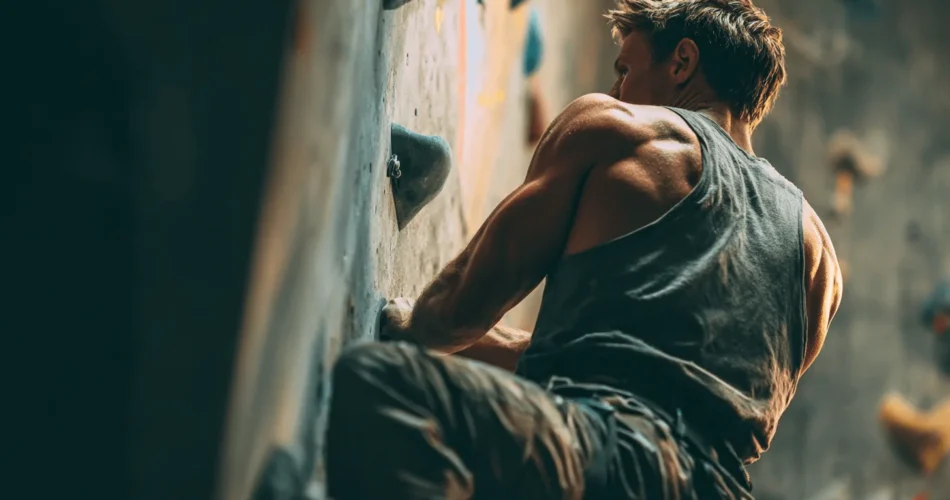
If you’re new to the crag or the gym, you might be asking: is rock climbing really a full-body workout, or is it just about having ridiculously strong arms? The answer is simple: rock climbing is an intense, holistic, full-body resistance exercise that strengthens muscles from your fingertips to your toes.
Unlike traditional weightlifting, which often isolates muscle groups, climbing requires the seamless integration of your entire musculoskeletal system—meaning you build a strong, lean, and functional physique. Let’s break down the muscle groups that power your ascent and reveal the unsung heroes of your climbing body.
Related Articles
How Many Calories Does Rock Climbing Burn?
How to Increase Grip Strength for Rock Climbing
What to Wear Rock Climbing
Rock Climbing: The Pillars of Muscular Engagement
When you climb, your body constantly works against gravity to stabilize itself. This activates distinct muscle groups simultaneously, improving strength, endurance, and coordination.
Upper Body: The Pulling Powerhouse
Climbing movements are largely driven by pulling, which makes the upper body responsible for lifting your weight and maintaining contact with the wall.
Back and Shoulders: The Primary Engines
The back and shoulders generate the raw pulling power and provide crucial stability for reaching dynamic holds.
- Latissimus Dorsi (Lats): This large, flat muscle is the primary engine for vertical pull and is vital for pulling your body upward and keeping you close to the wall. Along with the forearms and core, the lats handle the bulk of sustained effort.
- Biceps: The biceps brachii, brachialis, and brachioradialis are activated during elbow flexion—the main action of lifting your body. The biceps are essential for “locking off,” which means holding a bent-arm position isometrically while the other hand reaches or the lower body moves.
- Trapezius and Rhomboids: These muscles stabilize the scapula (shoulder blade) and assist the primary pulling motions.
The Importance of Grip Strength (Forearms)
Your forearms are universally recognized as the muscles most heavily taxed in rock climbing, responsible for generating and sustaining the grip force needed for holds.
- Forearm Flexors (Flexor Digitorum Profundus/Superficialis): These are the primary drivers of grip, curling the fingers and generating the pulling force at the end of the kinetic chain.
- Forearm Extensors: These wrist extensors balance the intense work done by the flexors. They function as synergists, maintaining the wrist in an optimal angle of extension, which is necessary for the flexors to achieve maximal pulling force efficiently.
Core: The Central Pillar of Stability
A strong core acts as the central pillar of the kinetic chain, transferring force from your legs to your arms, maintaining body tension, and ensuring precise control.
| Core Muscle Group | Primary Role in Climbing |
| Transversus Abdominis | Critical for deep bracing, providing internal structural stability necessary for maintaining a rigid position. |
| Obliques (Internal/External) | Heavily utilized for twisting, rotating, and lateral movements, helping you reach offset holds. |
| Rectus Abdominis | Provides overall body tension, particularly during dynamic and explosive movements. |
| Erector Spinae | Support the spine and maintain an upright, balanced posture. |
This central rigidity is vital for conserving energy by minimizing wasted motion. For instance, core stability allows you to execute Flagging, a technique where you extend one leg out for balance, preventing your body from rotating off the wall (the “barn door” effect).
Lower Body: Pushing, Propelling, and Offloading the Arms
The lower body is often underrated, but strong legs are just as crucial as strong arms, helping to push upward and reduce strain on the upper body.
| Lower Body Muscle Group | Primary Function in Climbing |
| Quadriceps | Essential for pushing upward and extending the knee, particularly during high steps and mantles. |
| Hamstrings | Crucial for knee flexion and generating significant pulling force, especially in a lengthened position. |
| Gluteals (Glutes) | Used for hip extension and stability, providing power for upward movement. They also function as powerful external hip rotators. |
| Calves | Activated for precise footwork on small holds and for pushing off footholds (smearing). |
| Hip Flexors | Help raise the leg during high steps and assist in hip rotation necessary for reaching holds. |
Specific techniques place massive demands on your lower body strength and flexibility:
- Heel Hooks: This move requires significant hamstring strength in a lengthened position and engagement of the glutes (external hip rotators) to pull your body closer to the wall.
- Drop Knees: This footwork technique involves rotating the hip toward the wall and driving the knee down to increase reach and generate torque. It demands flexibility and strength from the internal hip rotators.
- Smearing: This involves pressing the rubber of your climbing shoe directly against the rock or wall to maximize friction, relying heavily on consistent pressure applied through the calf and foot muscles.
Beyond Pulling: Stabilizers, Antagonists, and Injury Prevention
Climbing is heavily dominated by pulling movements, which can lead to muscular imbalances (e.g., overdeveloped lats and flexors). Therefore, a comprehensive understanding of climbing muscles must include those that stabilize and oppose the main movement.
The Essential Antagonist Muscles
Antagonist muscles oppose the movement of the agonists. Training these counter-muscles is crucial for preventing common injuries like shoulder instability and elbow pain.
- Rotator Cuff (RC): Comprising four muscles (Supraspinatus, Infraspinatus, Teres Minor, Subscapularis), the RC provides dynamic stability to the shoulder joint. Since climbing involves overwhelming use of internal rotators (Lats/Pecs), specific training for the external rotators is essential for maintaining joint health and reducing injury risk.
- Triceps Brachii: While typically an antagonist to the pulling action of the biceps, the triceps transition into a primary functional agonist during the Mantle. Mantling, used to surmount a ledge, involves pushing down on a hold to elevate the body, relying heavily on the triceps for elbow extension.
Fact Check: If you routinely climb with inefficient bent elbows, focusing on Triceps strengthening will help offload the biceps. Similarly, if you experience inside elbow pain (medial epicondylitis), you need to strengthen your Wrist Extensor Muscles to counteract excessive wrist flexion.
Climbing Style Matters: Power vs. Endurance
The type of muscle development you gain depends largely on your climbing discipline, which dictates the physiological demands placed on your body.
| Factor | Bouldering (Short, Intense) | Sport/Traditional Climbing (Longer Routes) |
| Primary Physiological Demand | Explosive Strength, Power | Muscular Endurance, Efficiency |
| Dominant Muscle Fiber Type | Type II (Fast-Twitch) | Type I (Slow-Twitch) |
| Muscles Most Heavily Taxed | Fingers, Shoulders, Biceps, Core | Forearms, Latissimus Dorsi, Core |
| Muscle Growth Speed | Faster upper-body and core development due to high force and lack of ropes | Moderate, prioritizing muscle efficiency over size |
Bouldering is excellent for building muscle faster because it involves short, intense sequences that require high force production and explosive, dynamic movements, putting more reliance on upper-body strength. Conversely, Sport Climbing focuses on sustained effort, improving muscular endurance and efficiency over time.
Conclusion: A Functional, Full-Body Sculpt
So, does rock climbing build muscle? Absolutely!.
Climbing systematically strengthens your forearms, biceps, shoulders, core, and legs, leading to marked improvements in grip strength and overall muscular endurance. While it may not create the sheer bulk of traditional weightlifting, climbing sculpts a strong, lean, and highly functional physique. Every time you grasp a hold, pull yourself up with your lats, or stabilize your swing with your core and hips, you are giving your body a comprehensive workout.
For optimal results and long-term health, remember that training the often-overlooked stabilizer and antagonist muscles—like the rotator cuff and triceps—is just as crucial as building raw pulling power. Incorporate techniques like Flagging and Heel Hooks to make your legs work smarter, and you’ll climb stronger and longer.